

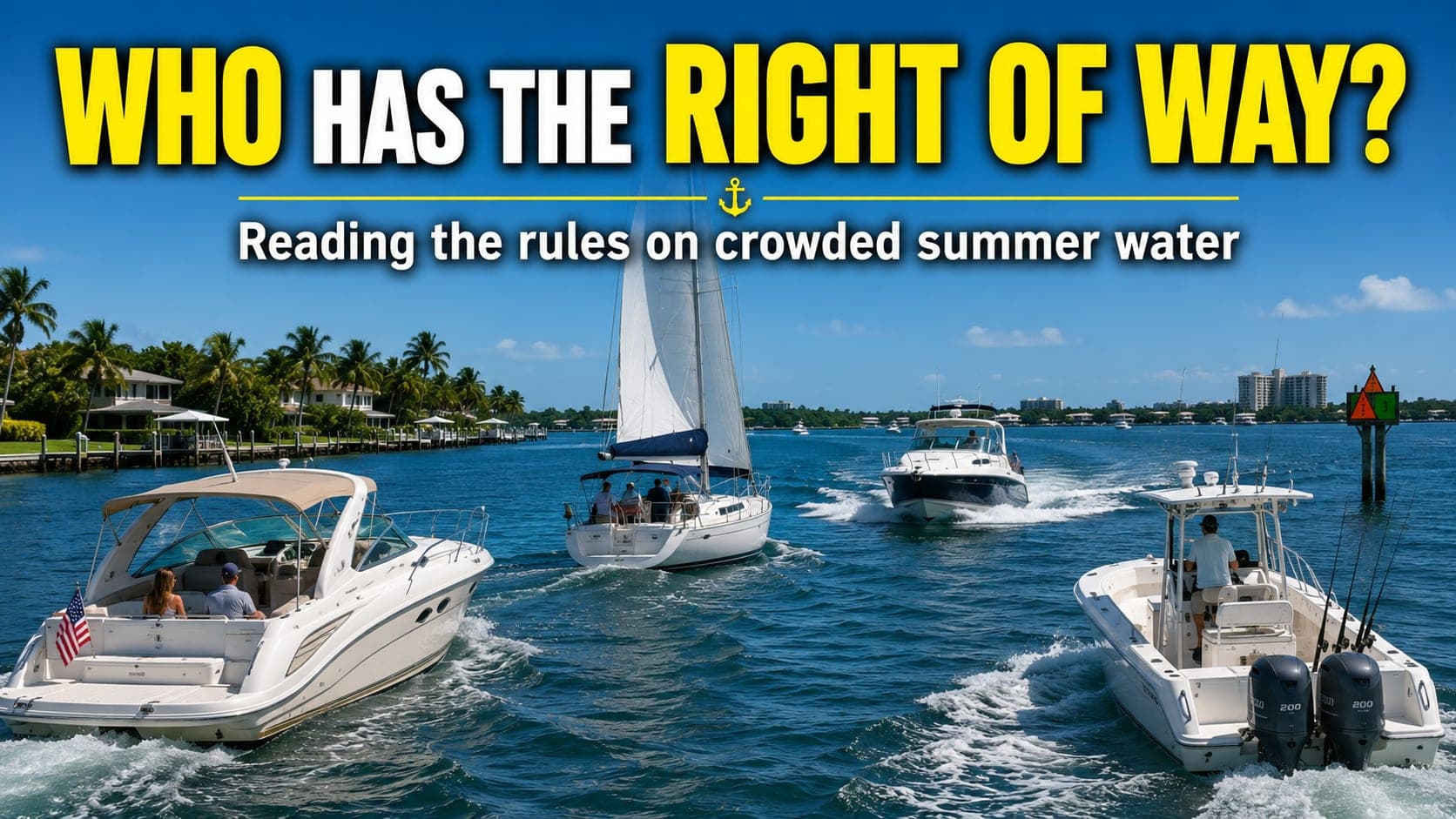

On a busy August weekend, the water in front of your marina can look more like a freeway at rush hour than an open bay. Boats crossing, overtaking, and cutting in from every angle, half of them driven by people who have never opened a rule book. That is exactly when knowing who has the right of way stops being trivia and starts keeping everyone off the rocks and off each other.
Here's the thing about the navigation rules: most boaters have a fuzzy sense of them and a lot of confidence, which is a dangerous combination. Let me walk you through what actually matters out there.
The Real Rule Is Avoid the Collision
Before we get into who yields to whom, understand the rule that sits above all the others: you are always required to do whatever it takes to avoid a collision, even if you technically have the right of way. The rules use two terms. The give-way vessel is the one required to change course or speed to stay clear. The stand-on vessel is the one expected to hold a steady course and speed so the other boat can predict what it's doing.
But stand-on does not mean bulletproof. If the give-way boat isn't yielding, you are still obligated to act before it becomes a crash. Nobody at the accident investigation cares who had the right of way when two boats are stuck together. The real question is whether you did everything you could to prevent contact.
Powerboats, Sailboats, and Who Yields to Whom
The general pecking order is built around maneuverability: a boat that can't get out of the way easily gets priority over one that can. A vessel not under command or restricted in its ability to maneuver comes first, then boats commercial fishing with gear in the water, then sailing vessels under sail alone, and finally powerboats, which give way to almost everyone.
The one that trips people up is power versus sail. If you're running a powerboat and a sailboat is actually sailing, you give way. The moment that sailboat fires up its engine, though, it becomes a powerboat under the rules and the usual power-to-power logic applies. And none of this lets a sailboat bully a big ship in a narrow channel, because a freighter that can't stop or turn is the one boat everyone yields to.
Crossing, Meeting, and Overtaking
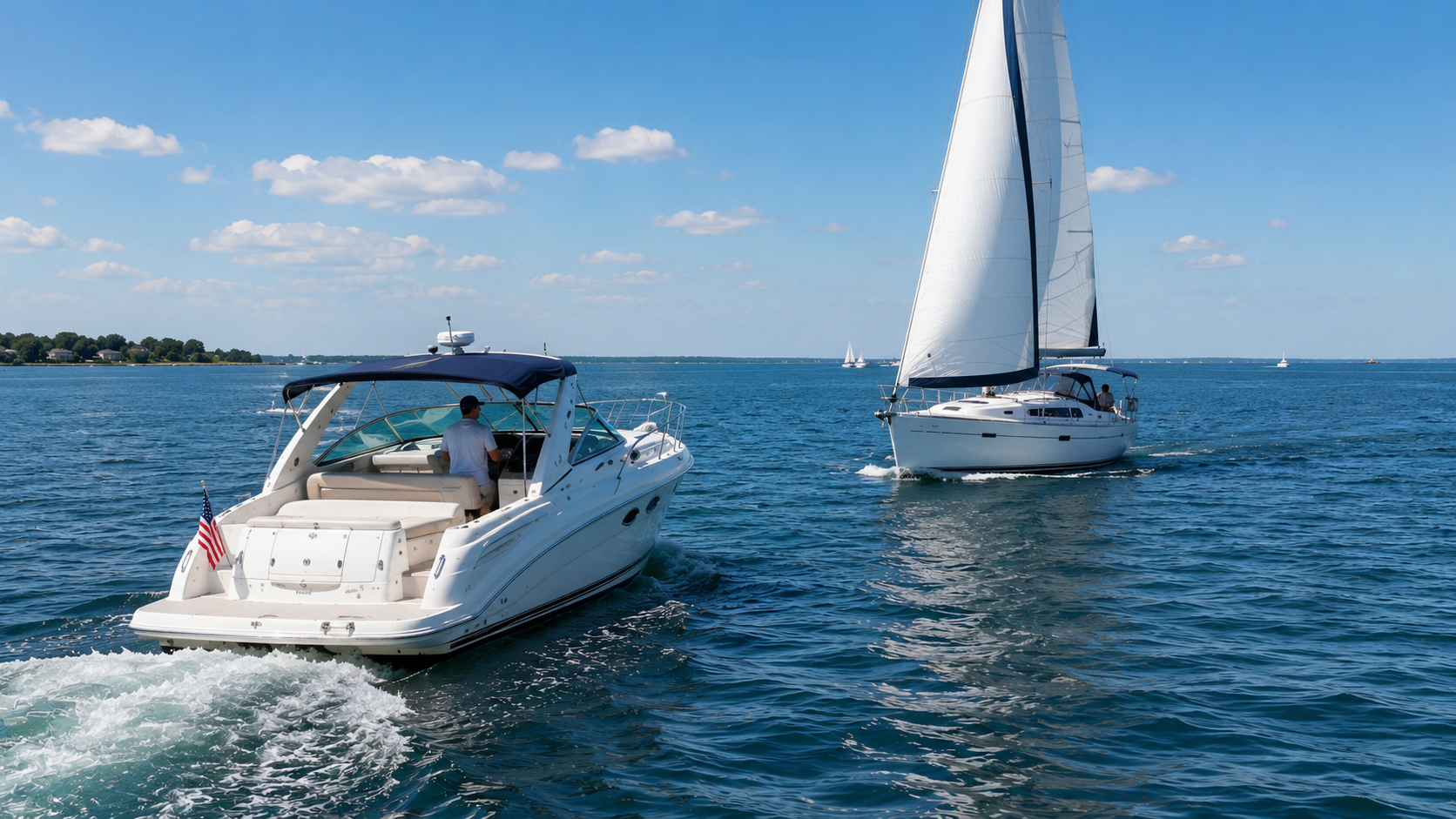
Between two powerboats, three situations cover almost everything. Meeting head-on, both of you turn to starboard and pass port to port, the same as cars keeping right. Crossing, the boat that has the other on its starboard side gives way, so if a boat is approaching from your right, it's your job to slow or turn behind it. Think of your starboard side as the side you have to respect.
Overtaking is the simplest to remember and the easiest to get wrong. If you're catching up to another boat from behind, you are the give-way vessel, period, whether it's power or sail. The boat being passed holds its line, and you go around wide enough that your wake doesn't rock its deck. Reading the marks around you matters just as much, which is why knowing how to interpret the buoys and channel markers is part of the same skill set.
[IMAGE 1: A powerboat and a sailboat on crossing courses in open summer water, bright midday light, calm blue water, clearly showing two vessels approaching from different angles. No text.]
The Situations That Actually Cause Summer Collisions
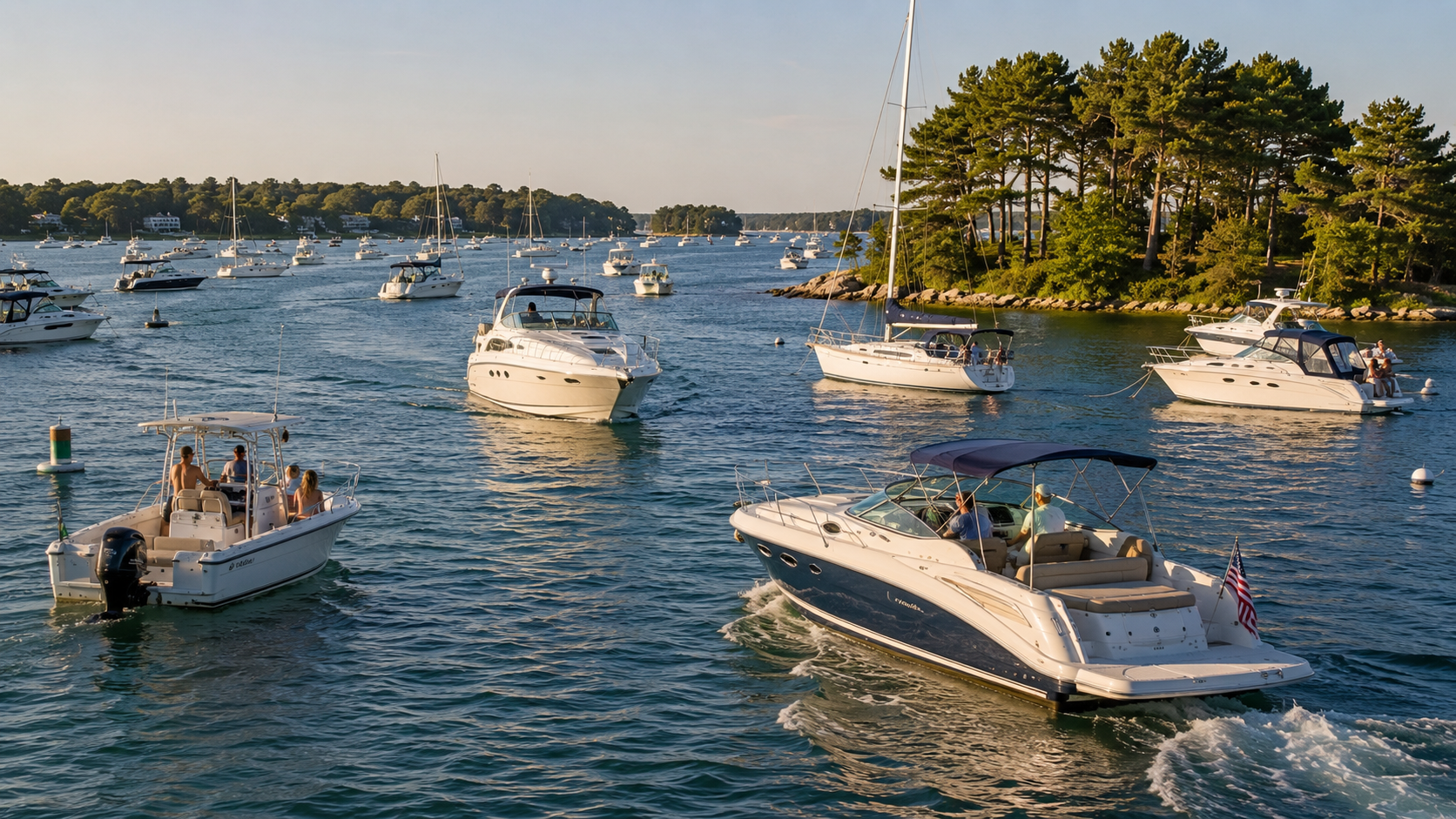
The rules assume both boats can see each other and are paying attention, and summer is when both assumptions break down. Sun glare hides an approaching hull until it's close. A packed anchorage means boats getting underway with people still swimming nearby. Narrow channels funnel traffic into tight spaces where there's no room to give way properly, so slowing down becomes the only real option.
Then there are the blind spots. A boat with the bow riding high under acceleration can't see a small craft dead ahead, and a driver towing a tube has his eyes split between the water and the rider. When the light fades it gets harder still, and running safely after dark is a discipline of its own before you try it in traffic. Assume the other guy hasn't seen you until you're sure he has.
[IMAGE 2: A busy summer anchorage or channel with several boats maneuvering carefully around each other, wakes visible, warm afternoon light. No text.]
Communicate, Slow Down, and Assume Nothing
When intentions aren't clear, don't guess. Sound signals still work, one short blast to say you're altering course to starboard, two for port, and five or more to say you have no idea what the other boat is doing. In tighter or busier situations a quick call on the radio clears up ambiguity fast, which is one more reason to be comfortable working your VHF radio the right way instead of leaving it switched off.
Most of the time, though, the fix is just speed. Back off the throttle and buy yourself time to read the situation. A boat moving slowly has options; a boat moving fast has regrets. Being the calm, predictable operator out there is worth more than being the one who was technically right.
Run It Like Everyone Else Skipped the Rule Book
Learn the rules cold, then drive as if nobody around you knows them, because on a busy summer day half of them don't. Give way early and obviously, hold your line when you're the stand-on boat but stay ready to bail, and keep your speed low enough to react. That combination gets you through the busiest weekend of the year without a scare.
How do you handle the chaos of a packed waterway on a holiday weekend? Drop your approach in the comments, along with the closest call you've had out there and what you took away from it.