

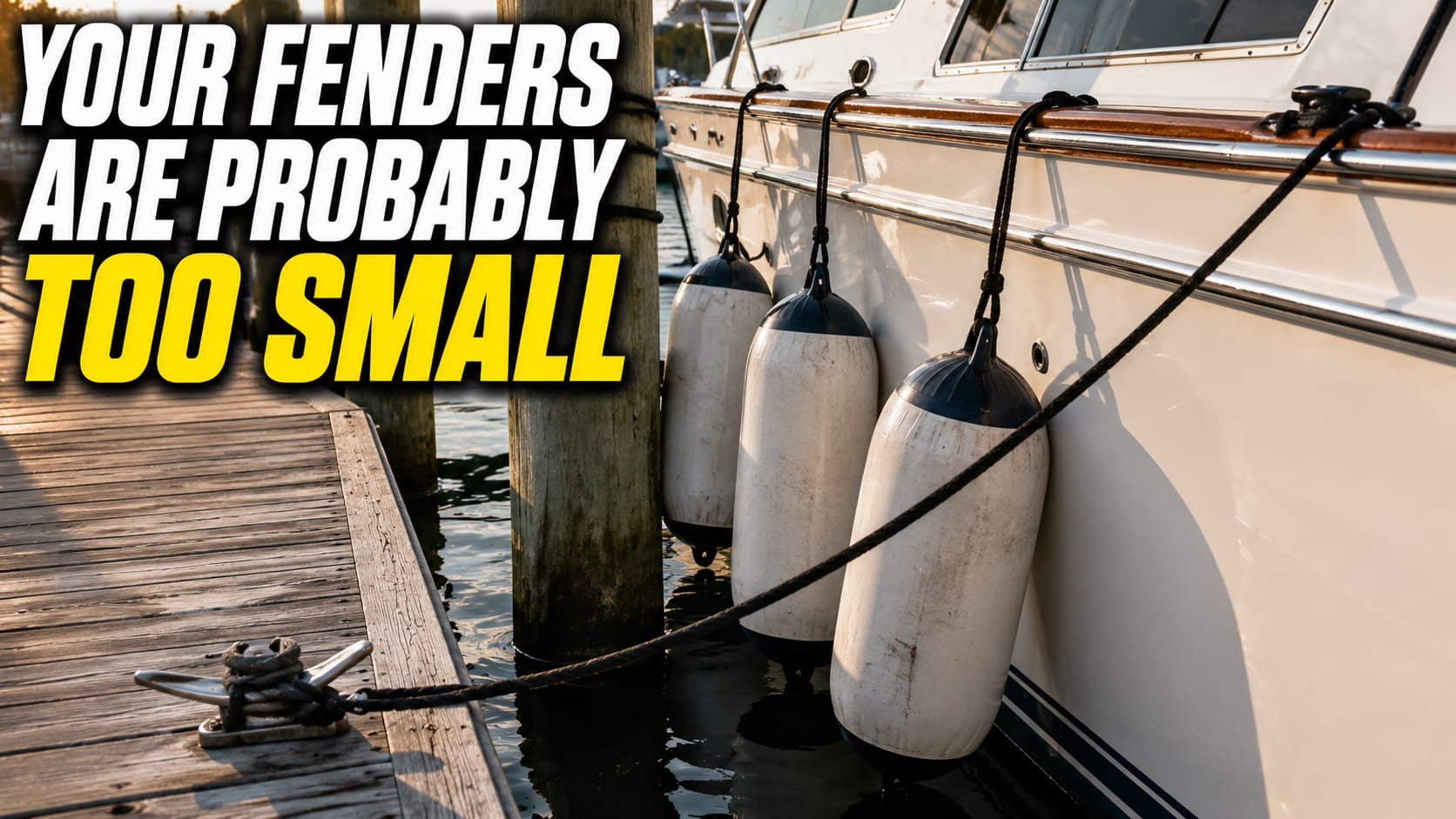

Nobody posts a photo of their fenders. They are the least interesting thing you will ever buy for your boat, they live in a locker most of the season, and they cost a fraction of almost anything else on board. They are also the only thing standing between your gelcoat and a concrete piling when the wind pipes up at three in the morning.
Dock lines are the same story. Most boats I walk past are tied up with lines that are too short, too stiff, or a size too small for the boat, and the owner has no idea because it has not caused a problem yet. It usually does not — right up until it does.
You Almost Certainly Have Fenders That Are Too Small
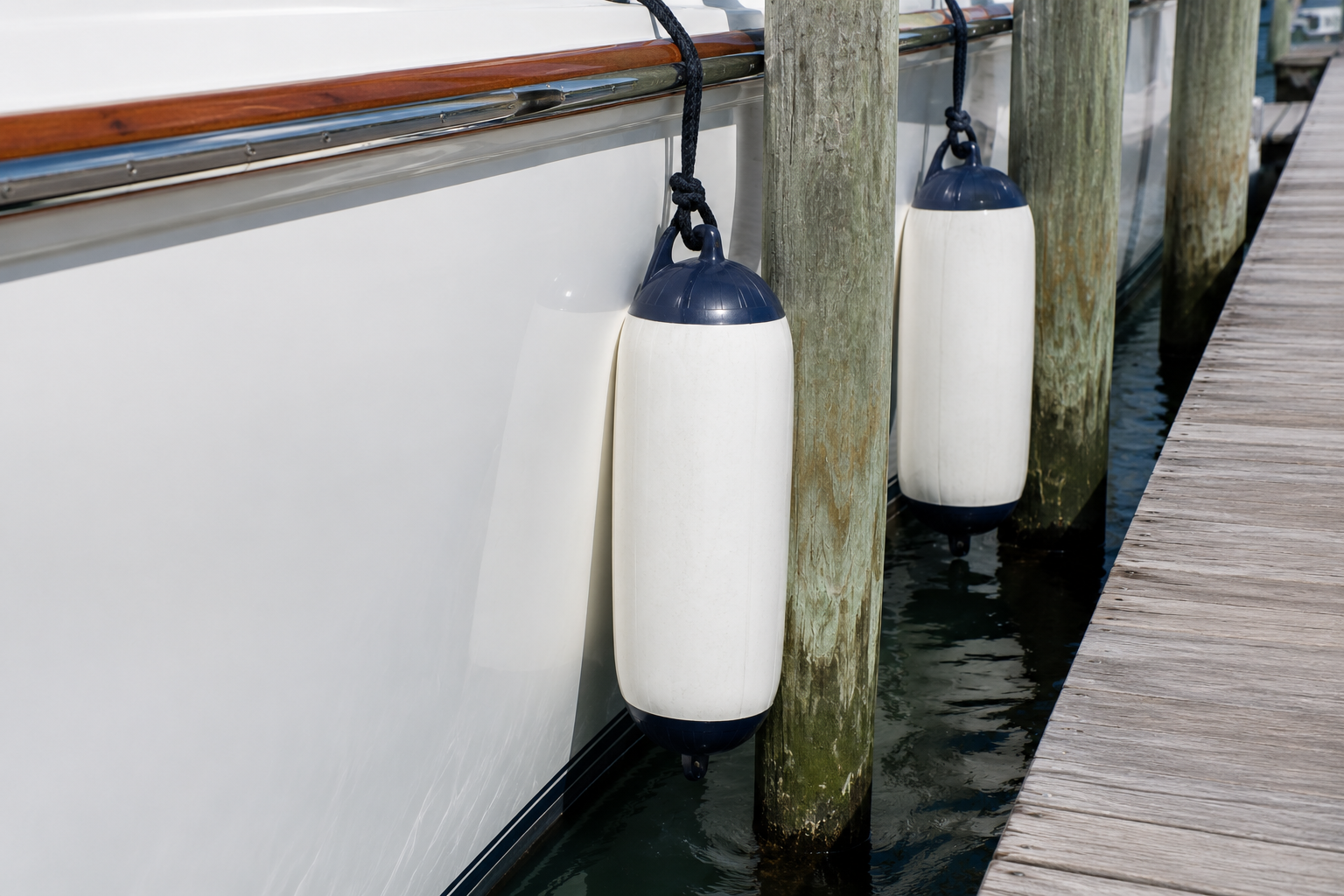
The rough rule is one inch of fender diameter for every four to five feet of boat, with a minimum of three fenders on any boat you tie up alongside. A thirty-foot boat wants something in the eight-inch range, not the six-inch fenders that came with it when you bought it. Undersized fenders compress completely under load, and a fully compressed fender is just a firm spacer that transmits everything straight through to the hull.
Height matters as much as diameter. A fender hung so it rides above the rub rail or below the dock edge is decorative. It needs to sit where the boat actually contacts the dock at the tide state you will be leaving it in, which means adjusting it rather than tying it once in spring and forgetting about it. On a floating dock that is straightforward. On a fixed dock with real tidal range, a fender board spanning two fenders will do more for you than any number of individual fenders, because it rides the pilings instead of rolling off them.
Line Size, Length, and Why Nylon Matters
Dock lines should be three-strand nylon, and the stretch is the entire point. Nylon absorbs shock loads from wakes and gusts by elongating, which is exactly what you want between a moving boat and an immovable dock. Braided polyester feels nicer in the hand and holds up well, but it barely stretches, so every surge gets transmitted to your cleats and your hull instead of being absorbed by the line.
For length, your bow and stern lines want to be about two-thirds of your boat length, and spring lines should run the full length of the boat. Diameter follows the same logic as fenders — roughly an eighth of an inch for every nine feet, so most boats under thirty feet are happy on half-inch line. Oversized line is not safer, incidentally. It does not stretch enough under normal loads to do its job, and it is harder to handle. And all of it assumes you can tie the thing off properly, which comes back to knowing a handful of knots cold rather than improvising at the cleat.
Springs Do the Real Work
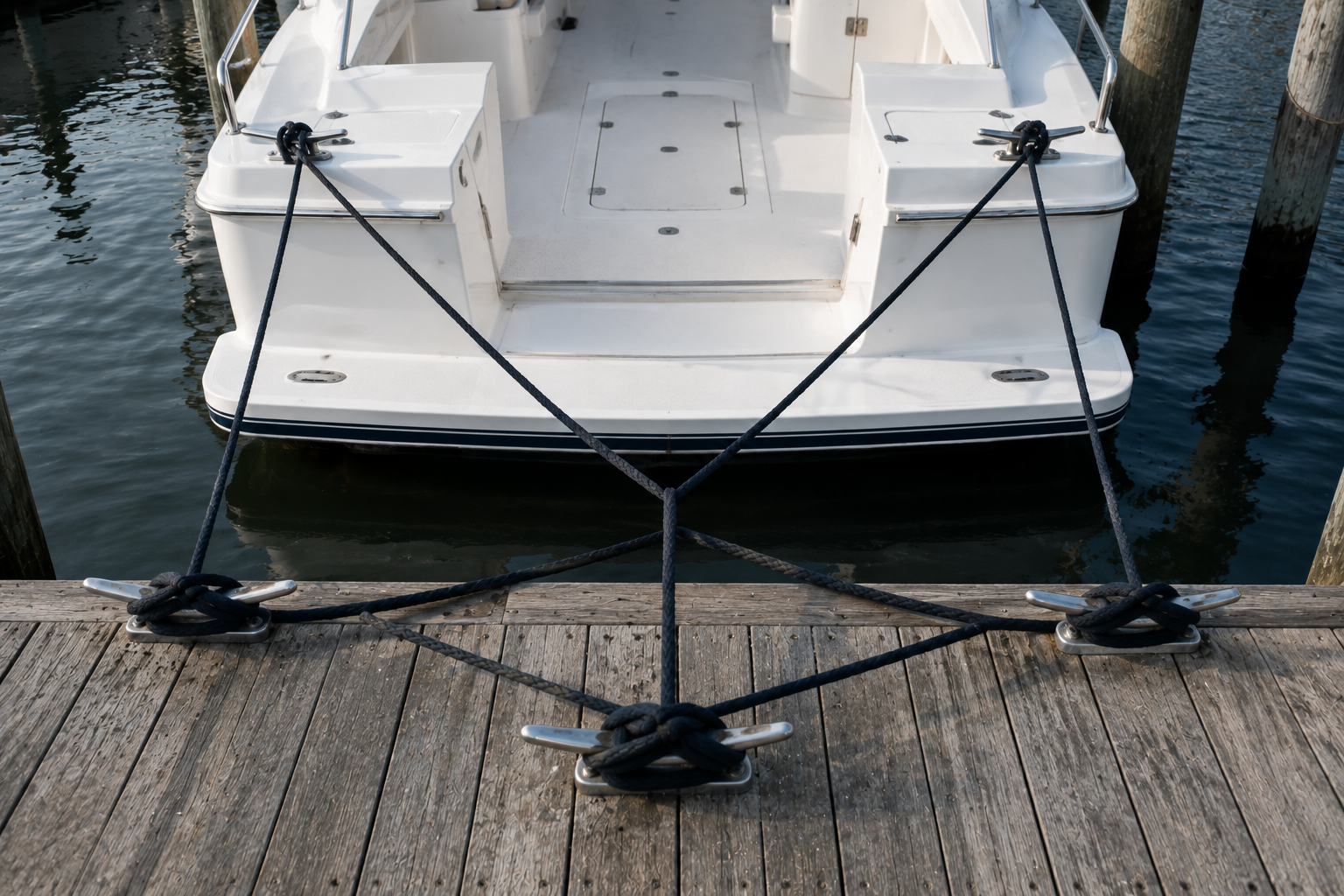
Bow and stern lines keep the boat attached to the dock. Spring lines keep it from surging forward and back, and they are the ones most people skip. A proper setup uses four lines: bow, stern, and two springs running in opposition, one from a forward cleat aft to the dock and one from an aft cleat forward. Set up that way, the boat is held in a box and cannot walk itself along the dock as boats go by all afternoon.
This is the setup that matters most when you are not there. A boat left on bow and stern lines alone will work back and forth with every wake, chafing the lines and grinding the fenders along the hull. Add the springs and the whole thing settles down. The same principle applies when you tie up alongside other boats — the loads want to be spread across lines pulling in opposition, not concentrated on two.
Chafe Is What Actually Breaks Lines
Lines almost never fail in the middle. They fail where they cross a chock, a rail, or a rough cleat horn, and that wear happens slowly enough that you do not notice until you are looking at a line that is half its original diameter. Chafe gear can be as simple as a length of old hose split lengthwise and lashed in place where the line passes over the edge.
Give your lines a real look a couple of times a season. Run them through your hands and feel for flat spots, glazing, or fuzz where they pass through the chocks, and turn them end for end so the wear moves to a fresh section. Replace anything that feels stiff or looks chalky. It is a small amount of money and attention for the gear doing the most unglamorous work on the boat — and it saves you the sort of morning where you are the one holding up the line at the ramp sorting out a mess you could have prevented. If you have a chafe trick that works, I would like to hear it in the comments.
