



The marine battery aisle is one of the most confusing places on the planet to spend a weekend afternoon. Three chemistries, four labels that all sound the same, twice the price for the one with the gold sticker, and a guy on the dock who swears by something the parts counter has never heard of. I've gone through a few of these decisions on my own boat over the years, and the through-line is always the same — pick the battery that matches how you actually use the boat, not how someone else uses theirs.
If you're staring at the rack and trying to figure out what to do, here's the honest version of the conversation.
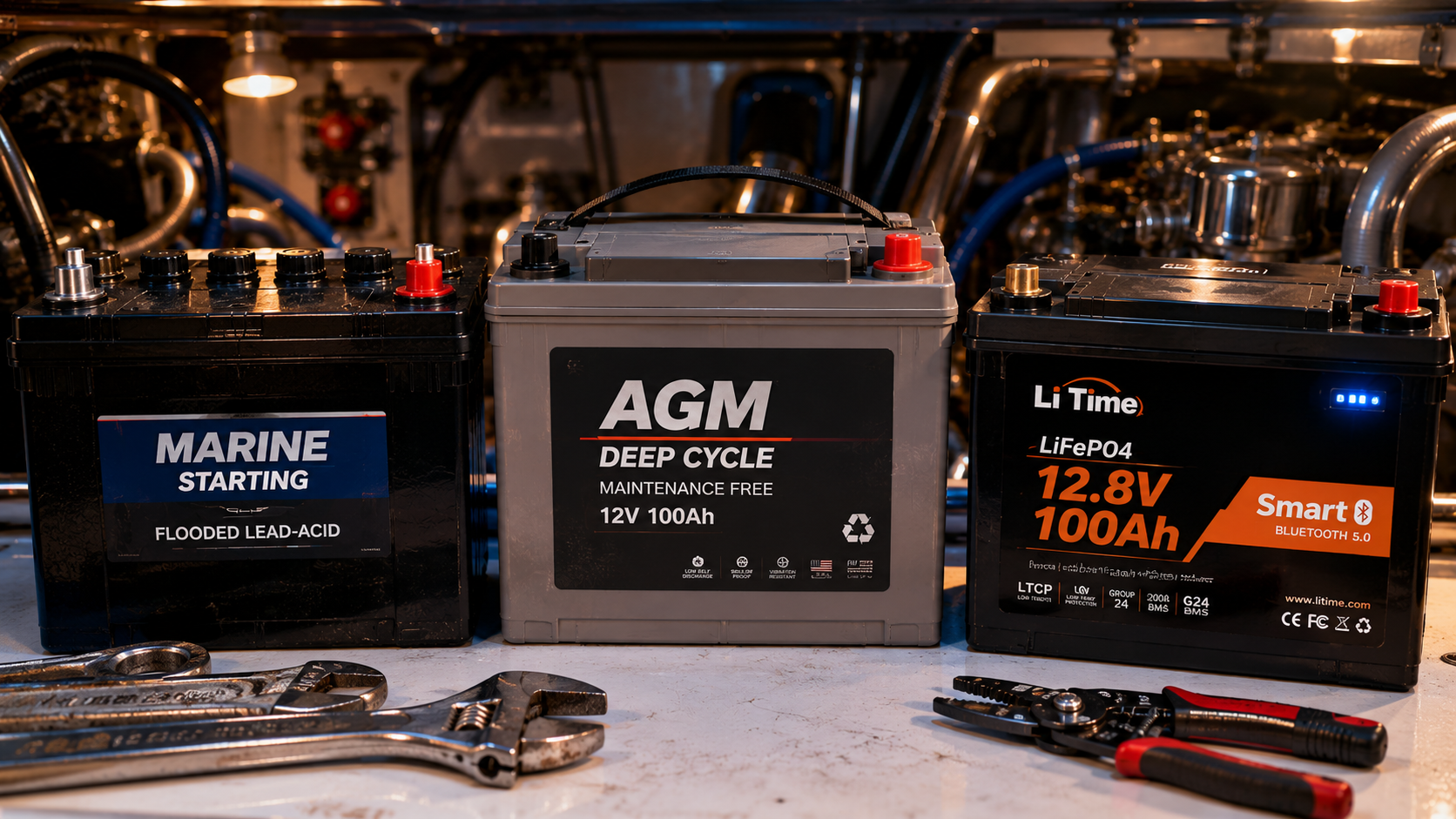
Flooded, AGM, or Lithium — The Honest Comparison
Flooded lead-acid batteries are still the cheapest option, and for a small day boat that gets used a couple of times a month, they're hard to beat on price. The downsides are real, though. They off-gas, they need to be checked for water, they don't love being installed sideways, and they don't tolerate being run down hard. If you forget to charge them over the winter, you're buying new ones in the spring.
AGM is the sweet spot for most powerboats. Sealed, vibration tolerant, no maintenance, and they hold a charge in storage much better than flooded batteries. They cost about double, but they last longer if you treat them right and they're the right call for almost any cruising boat that isn't going off-grid for days at a time.
Lithium is a different conversation entirely. The upfront cost is real — three to four times an equivalent AGM — but lithium gives you almost the full rated capacity, charges fast, and doesn't care if you discharge it hard. If you're running a refrigerator, an inverter, electronics, and a windlass off the house bank for a weekend at anchor, lithium is the system that doesn't make you stingy. I went with a LiTime 12V 320Ah lithium on my own house bank — drop-in form factor, internal BMS, and a real-world capacity that turned the way I use the boat upside down. I walked through the install of the DC-to-DC charger that the upgrade requires, because you can't just drop lithium in and expect the existing system to charge it correctly.
Sizing the Bank for How You Actually Use the Boat
The fastest way to end up with the wrong battery is to size for an average day instead of a hard day. Add up everything you draw from the house bank when you're really using the boat — refrigerator hours, chart plotter hours, autopilot hours, anchor light hours, the inverter you turn on for the coffee maker. Multiply that against the longest night you'll actually spend at anchor, then double it. That's your usable capacity target.
On lead-acid (flooded or AGM), you only get to use about 50 percent of the rated amp-hours before voltage drops below where things start drawing harder than they should and lifespan takes a hit. So if you need 100 usable amp-hours, you're shopping for a 200 amp-hour bank. On lithium, you can use almost the entire rated capacity, which is why a 100 amp-hour lithium battery does the work of a 200 amp-hour AGM at half the weight.
The Charging Side Most People Get Wrong
A battery is only as good as what's charging it. The alternator that came on the boat was sized to keep the starting battery topped off — not to bulk-charge a house bank. If you've added capacity without upgrading the charging side, you're going to be running lower than you think.
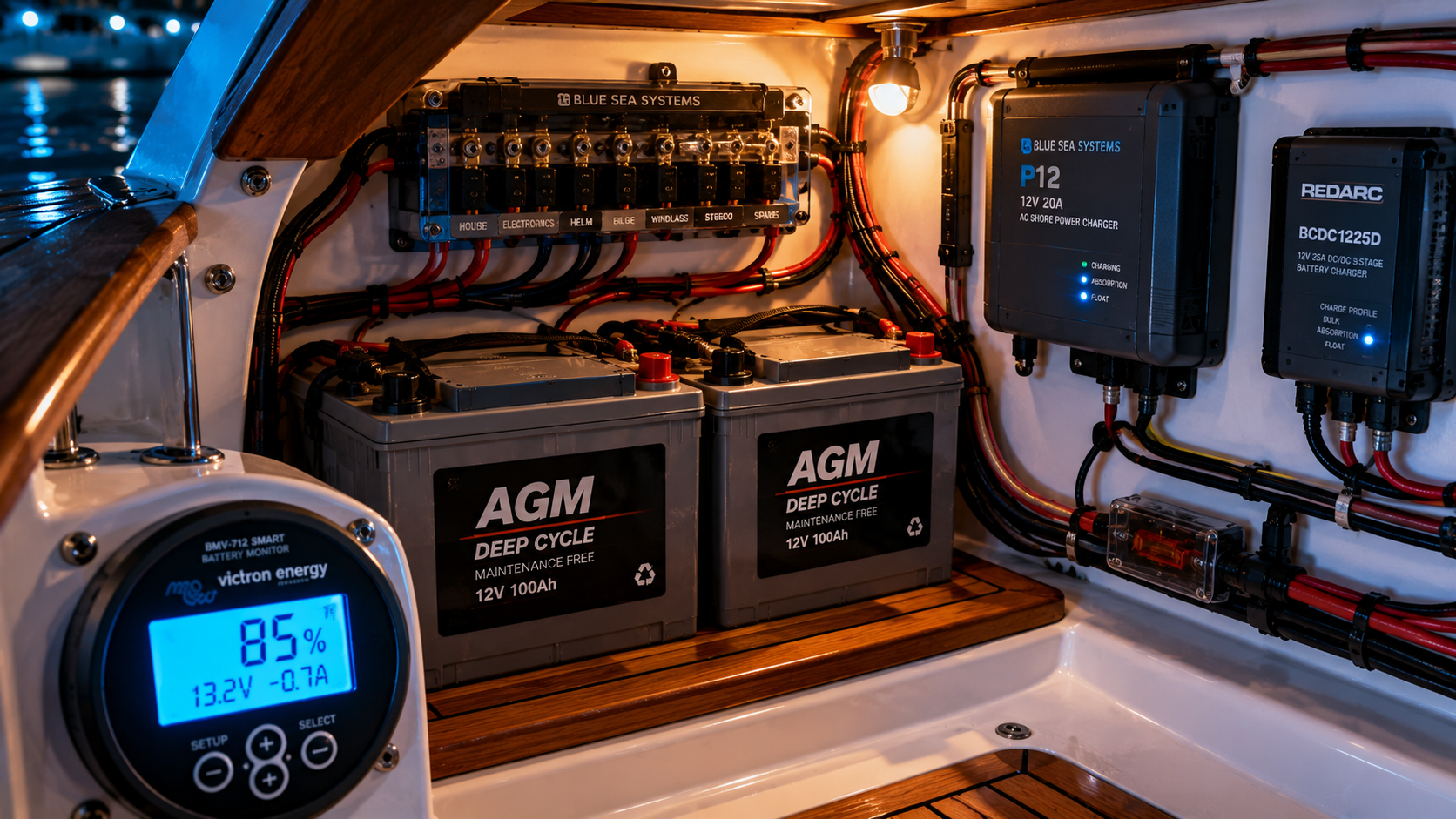
Get a real shore-power charger sized for your bank (rough rule: 10–20 percent of bank capacity in amps), a solar input if you anchor a lot, and the right DC-to-DC charger if you're running lithium house with a lead-acid start system. Most of this you'll source through a marine retailer like Defender, which is also where the Victron Orion DC-DC charger I used on my own install came from — they keep the chemistry-specific charge profiles dialed in instead of treating every battery like a flooded lead-acid.
And get a monitor. You cannot manage what you cannot see — which is why I put a Victron BMV-712 Smart on the bank the same weekend the lithium went in. State of charge, voltage, and current draw at a glance changes the way you use the bank. If you want the full install rundown, I wrote it up in a separate piece.
Signs Your Battery Is Done (Even If It Still Reads 12.6V)
Voltage on its own is a lousy indicator of a battery that's actually healthy. A battery that reads 12.6V at rest might collapse to 11.5V the second you turn on a load. The real tells are how the battery behaves under a load test — does it hold voltage when you fire the windlass, or does the chartplotter brown out for a second? Does it take a full charge and then bleed down overnight even with everything off? Are the cell voltages on a multibank balanced?
The other tell is age. Flooded batteries used on a recreational boat are usually done at three to five years. AGM stretches to five to seven on most boats. Lithium goes a decade or more if you don't abuse it. If yours is past the upper end and you're starting to find yourself babying it on weekends, the battery has already made the decision for you.
Closing Thought
Buying a marine battery is one of those decisions where the cheap option is almost always the expensive option in the long run. Match the chemistry to how you actually use the boat, size for hard days instead of easy ones, get the charging side right, and put a monitor on the bank so you're not guessing. Do that once and you've solved a problem that most boaters re-solve every couple of years for the rest of their time on the water.