


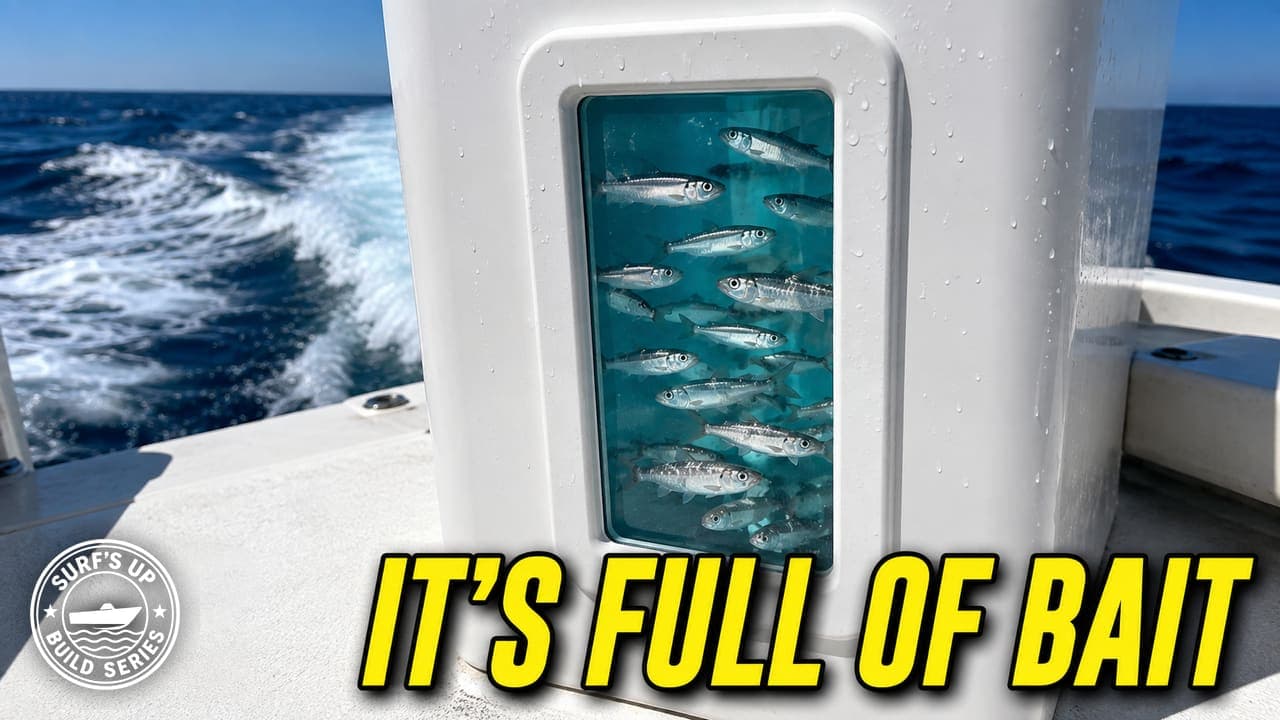

A bait tank is the single biggest upgrade you can make to a fishing boat. The problem is that once you bolt one down, you've handed over a chunk of your aft deck for good. That was my hangup on Surf's Up, the 29.5 Crystaliner I've been rebuilding. It's been an El Niño summer here in Southern California and I wanted live bait for it, but not badly enough to lose the deck year-round.
So I built mine to come off. The tank is a 40-gallon unit from Blue Water Bait Systems, built locally in Costa Mesa. It mounts to a deck hatch, so when I don't need it the whole thing lifts out and I still get at what's underneath. That one requirement changed how every other part of this install had to be done.
Sizing the Livewell Pump Is the Part People Get Wrong
I assumed you grab whatever livewell pump is on the shelf. There's more to it. Start with tank volume, because you want the water in that tank replaced ten to twenty times an hour. Mine holds 40 gallons, which puts me at an 800 gallon per hour pump. Just know the number on the box is an optimum flow rate — they drop the pump in water and count what shoots out. That's not what you get once the water has to climb through a scoop, a thru-hull, a reducer fitting, the pump itself, and ten feet of hose. Mine may end up being a little light.
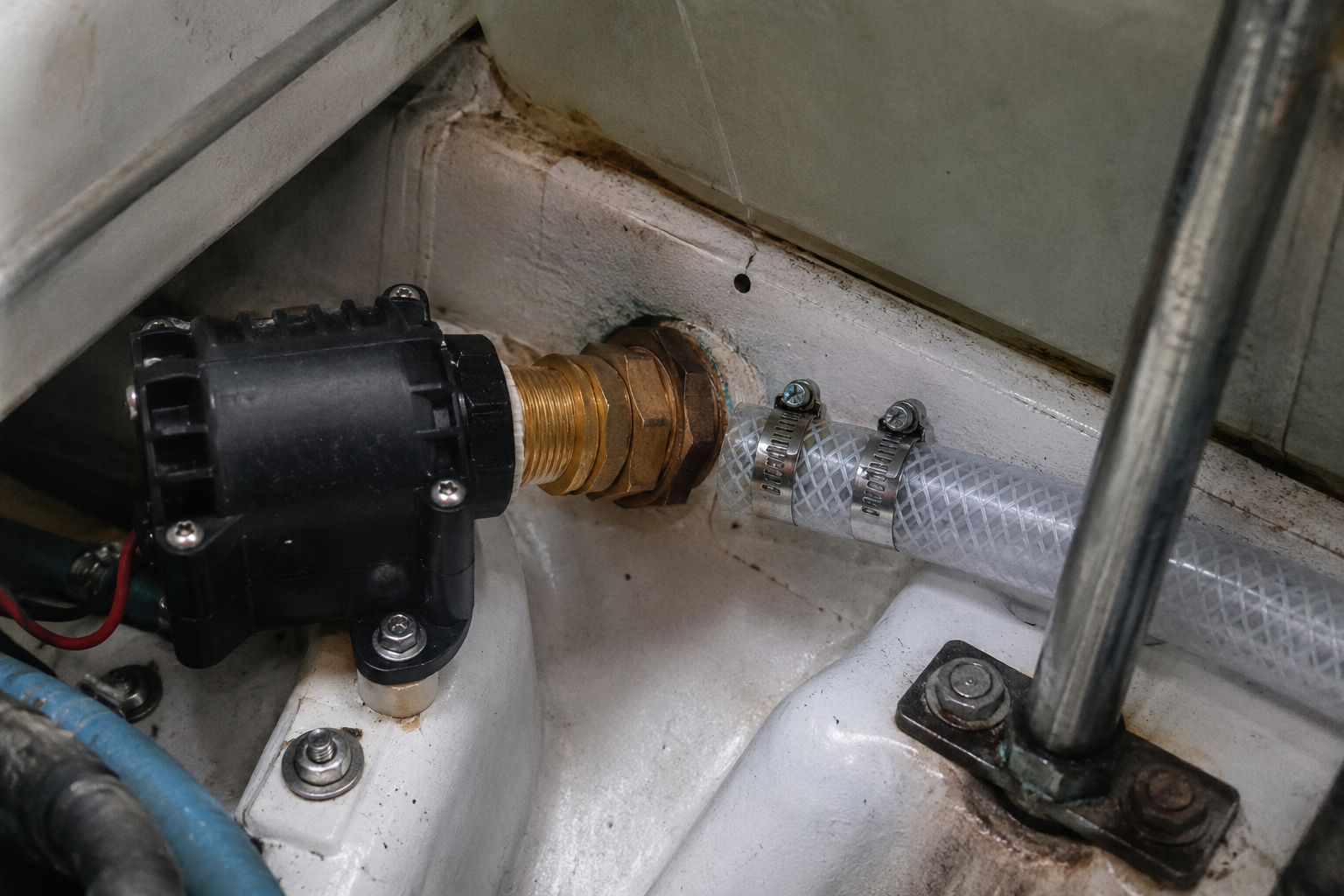
One thing to check before you buy: this style of pump threads onto the thru-hull, so underway with a scoop feeding it, the motor head can pop off. Make sure yours is rated to run with a scoop — some manufacturers run screws through the housing so it can't separate at speed.
Plumbing the Intake Side
Fair warning: the thru-hulls were already in my hull — the inlet is left over from this boat's Long Beach Fire Department days, and a previous owner plumbed the stern overflow. Starting from bare fiberglass means hauling out, drilling, and bedding fittings in 5200, which is its own project.
I needed a brass reducer to step down from thru-hull size to the livewell inlet, and I sealed it with liquid pipe joint compound instead of tape. Tape puts a lot of pressure on the plastic side of a fitting, and threading brass into plastic is exactly how you crack something. Compound on the pump side first, fitting hand snug. The brass-to-brass joint at the thru-hull can take a wrench — just watch you're not cross-threading.
The tank sits about six feet from that thru-hull, so I ran the hose under the fuel tank and down the center of the bilge. I keep gear in the side compartments and don't want a hose pinched, and down the middle it isn't damming water that needs to move forward or aft. Pull it tight so it can't kink. Double clamps on every seawater connection, facing opposite directions, so uneven pressure still covers the full circumference. Then it's spliced in, fused, and on its own switch. The hardware came from Defender Marine, and their Outfitters line will walk you through it over the phone.
Mounting the Bait Tank to a Hatch Instead of the Deck
This is where the removable requirement earns its keep. I cut a hole in the center of the new deck hatch for the hoses. Blue Water includes a starboard ring for exactly this, so I mounted it, cut my hole to match, and sealed the edge with white 4200 — now water that works under the tank drains around the hatch instead of into the bilge. Two parallel pieces of starboard sit just inside the tank's inner wall; the tank drops over them and bolts through the sides, pre-drilled together so the holes line up.
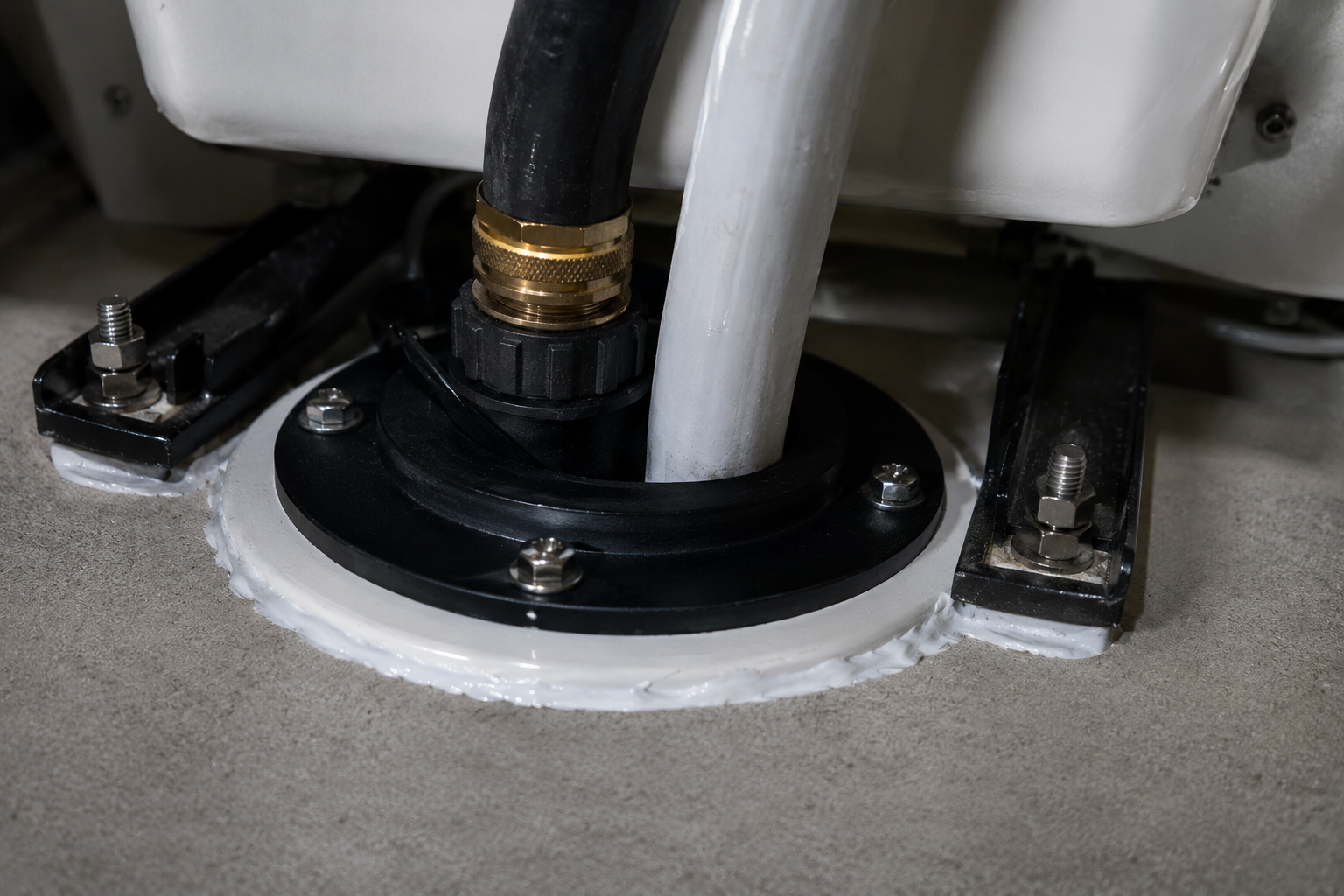
The plumbing had to come apart just as easily. The existing outlet is an inch and a half, so I cut that waste hose in half and pushed a threaded barb in with a clamp. Two clamps on the inlet, one on the outlet, since I can shut the inlet off and that line is gravity fed anyway. The inlet got a garden hose fitting as a quick disconnect — two fittings off and the tank lifts out.
Test It Before You Trust It
Two things I wanted from the first test. Watch the bilge, because you've just put a live seawater feed into your boat and the only acceptable result is a dry one. And time the fill, because that's your real flow rate instead of the number on the box. Flipped the switch, bilge stayed dry, and the 40-gallon tank filled in about five minutes on the dot. That's on the quick side, but the honest test is how bait behaves in it. Turns out keeping fish alive is harder than moving water.
I still need a scoop on the intake thru-hull; without one you don't get clean water forced up through the pump on plane. Adding it means hauling out, so it waits.
If you've followed this build from the start, this is a milestone. Episode one was the lithium bank I built, and the whole reason I sized it that way was to run a bait pump someday. A year later, here we are, and I can finally spend the rest of my money on rods and tackle. Watch the full walkthrough on the JakeSea YouTube channel, and if you've plumbed a livewell yourself, drop what you'd do differently in the comments.
Note: all external links (Blue Water Bait Systems, Defender Marine, livewell pump, hose) must be published with [target="_blank"] rel="noopener noreferrer". Internal setsalemarine.com links navigate normally.