



A 75-inch boat hook that rolls down to a five-inch cylinder and drops into a cupholder sounds like a gimmick. That was my first reaction to the Revolve Tec USA boat hook and deck brush combo. It claims to replace two essential tools with one compact design, so I put it through a series of side-by-side tests against the traditional gear I already trust, to see whether it can actually scrub, push, pull, and grab.
What the Revolve Tec Actually Is
The pole is built from Revolve's composite, a weave layered so it holds its shape and strength while still flexing enough to roll up. The storage advantage is obvious: a 75-inch pole that coils into a cylinder about five inches across. But the composite brings a couple of perks that matter specifically on a boat. The whole thing weighs under a pound, 0.8 to be exact, and a bit of foam on the handle keeps it floating if it ever goes overboard. Because it is composite, you can pull it out of saltwater and stow it wet without worrying about corrosion, and it will not oxidize or leave stains the way an aluminum pole can. The only non-composite part is a small pin that locks your chosen attachment in place. My kit came with two heads, a boat hook and a deck brush, each connecting through stainless steel adapters.

Deck Brush Test: Where Traditional Still Wins
First up was scrubbing, with the Revolve going head to head against a Shurehold aluminum pole running a similar brush head. The job was to clean a deliberately gross mix of oatmeal, tuna, and gravy off my deck. The flexibility of the Revolve takes some getting used to. The lengthwise bend is easy to adapt to and even helps, adding a little spring that keeps the brush head flat on the deck. The twist is the harder part. I like leaning into the corners of a brush to dig out the stubborn spots, and the rollable shell just does not resist twisting the way a rigid pole does. For pure scrubbing, the win goes to the traditional brush. The Revolve got the job done, but it struggled whenever I worked it on its side.
Boat Hook Test: Stronger Than I Expected
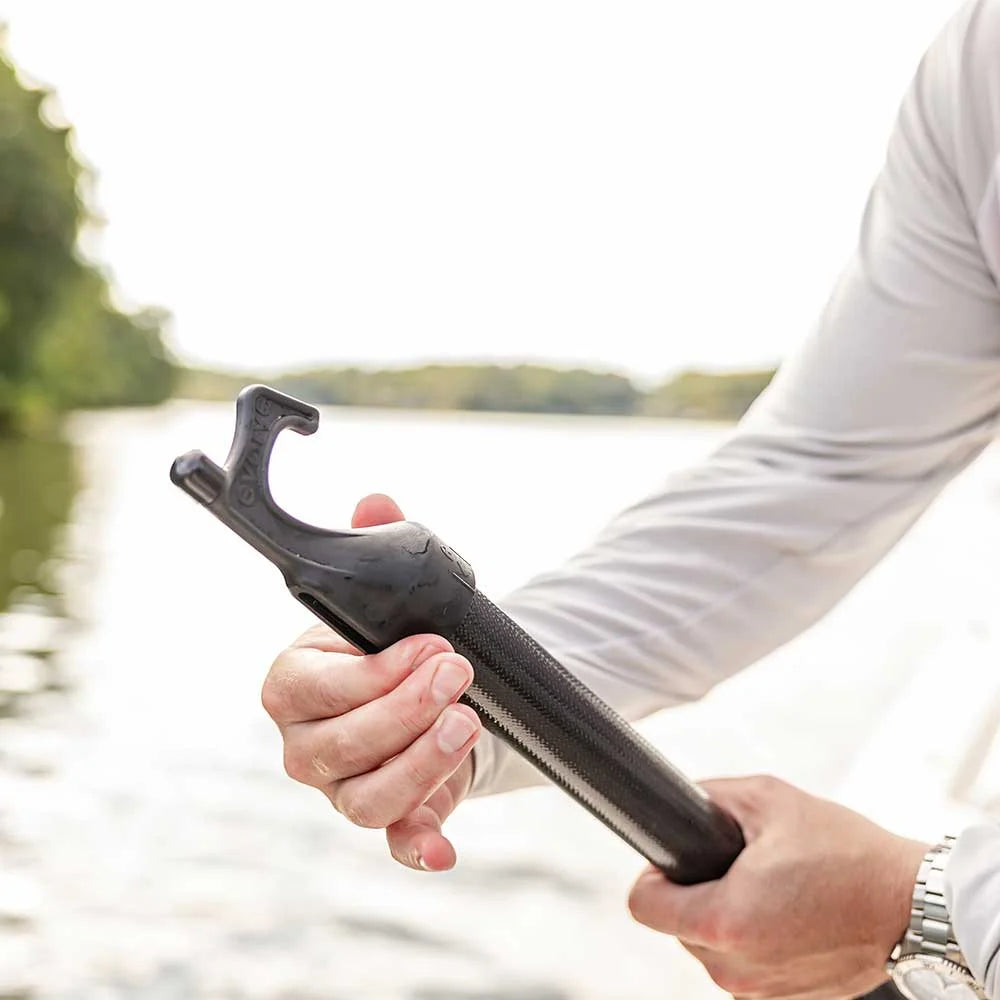
With the hook attachment on, I matched the Revolve against a West Marine extendable boat hook, a common budget pick. I set both to equal lengths and hung a bucket of water off each to test bending strength. On the footage, the Revolve held its own. Orientation matters here: the strongest position is with the gap facing upward, which is how the hook is designed to sit.
Then I took it where I actually use a boat hook 99 percent of the time, my mooring field. The lines get twisted and I need the hook to pull them around each other, and since I am usually singlehanding, it has to be strong enough to haul the boat up to the mooring until I get the first line on. I expected the flex to be a liability there. It turned out to be the opposite. The hook flexed with the line instead of letting it slip off. A push-off against a pylon confirmed the compressive strength held up, though I would be careful not to crunch the composite weave between a hull and a dock. To be fair, traditional poles do not love that either.
The Speed Test, and the Salt Problem
The last test was the one I care about most: how fast each tool deploys in an emergency. I ran a man-overboard drill with a fender standing in for the victim. In a fair, straight comparison the rollable holds its own. As long as you practice and keep the hook attachment handy, you can unroll it and snap the hook on in about the same time it takes to extend a traditional pole.
The drill also turned up the real story, and it works in the Revolve's favor. The traditional extending pole I was testing against jammed up with salt, which is exactly what telescoping metal poles do, and in my experience it happens about half the time. When that happens, the rollable wins easily, because the composite goes together the same whether it is bone dry, soaking wet, or caked in salt. Salt simply does not faze it. The one honest knock on the rollable runs the other way: it takes a little longer to pack away, and because it rolls down so small you might stash it in a cabinet, which can make it less instantly reachable in a hurry. But I have never been in a situation that required putting a boat hook away fast.
Who It Is Really For
The Revolve is not trying to beat tools built to do one job. It is trying to do two jobs in a fraction of the space, and that framing is the whole point. The real question is not whether it is a better boat hook than the one you have. It is whether you have room for a boat hook at all. Can you finally keep one aboard? Free up a rod holder? Clean a 14-foot Whaler on the run home before the fish guts dry, without a full-size deck brush taking over the cockpit? For boats where storage is the binding constraint, smaller boats and tenders especially, that is exactly where this thing earns its place.
The Verdict
I tested the Revolve against gear built to do one thing each, and it does two of them genuinely well. I am not retiring my old deck brush yet, but I have the luxury of storage space. For a lot of boaters, storage is the deciding factor, and on that score the Revolve solves a real problem without giving up much in performance. If space is your constraint, it is an easy recommendation.