


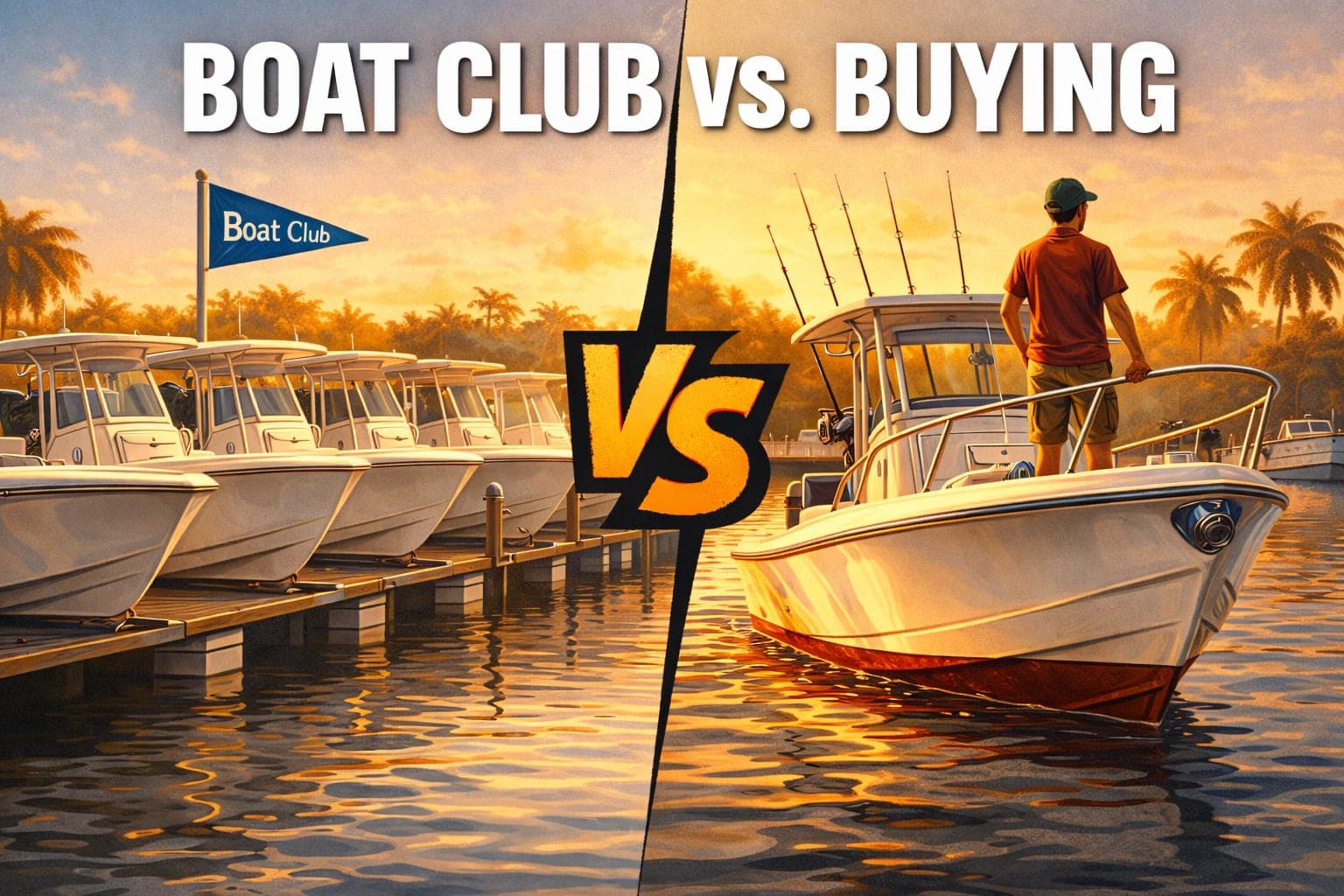

I get this question more than almost any other: should I buy a boat or just join a boat club? Five years ago the answer was simple — if you wanted regular time on the water, you bought a boat. Boat clubs, fractional programs, and peer-to-peer rental platforms have exploded since then, and I understand the appeal. But after years of watching how these programs actually play out for real boaters, my honest take is that buying your own boat is still the smarter move for most people who are serious about being on the water.
The real question is what kind of experience you want on the water. That depends on how often you go out, what kind of boating you do, and whether you’re okay handing over control of your plans to a scheduling app and a fleet you share with strangers.
How Boat Clubs Actually Work
A boat club gives you access to a fleet for a monthly or annual fee. Reserve a boat through an app, show up at the marina, take it out. When you bring it back, the club handles cleaning, maintenance, fuel, insurance, and storage. You never change an impeller, never argue with a mechanic, and never scrub a hull. The club owns the boats — you just drive them.
Most clubs focus on boats under 30 feet — center consoles, bowriders, pontoons — ideal for day trips, fishing, and casual cruising. Expect to pay a few hundred to over a thousand dollars a month depending on your market and the size of boats available.
Here’s the thing nobody mentions in the brochure: you are sharing those boats with every other member. And not every member treats the vessel the way you would. I’ve heard from countless boaters who show up for a reserved day only to find the boat they wanted is out of service because the last person ran it hard, damaged something, or left it in rough shape. Suddenly your Saturday on the water turns into a phone call with the club manager asking if there’s anything else available. You have zero control over how other people treat the fleet, and when someone else’s carelessness takes a boat offline, it’s your plans that get wrecked — not theirs.

What Fractional Ownership Offers Instead
Fractional ownership sits between a club and full ownership. You and a handful of other people buy the boat together, splitting purchase price, insurance, slip, and maintenance. A management company handles scheduling. You get time on a nicer boat than you could afford alone and build equity in a real asset.
The trade-off is flexibility — and it is a big one. You are locked into a schedule, and your co-owners all want the same holiday weekends. Customization is off the table. The same damage problem applies here too: if a co-owner runs the boat aground or neglects something during their time, you are stuck dealing with the fallout. And because fractional boats rack up hours fast with multiple owners pushing them hard, depreciation hits significantly harder than on a single-owner vessel. You are building equity in a depreciating asset that you cannot fully control.
The Real Cost Comparison
Here is where people get surprised — and where boat clubs do their best marketing. The average boat owner spends $25,000 to $30,000 a year once you add the loan, slip, insurance, fuel, maintenance, and haul-outs. A boat club membership for a comparable vessel runs $5,000 to $15,000 a year. On paper, the club wins. But here’s what that math leaves out: at the end of five years in a boat club, you own nothing. You have spent $25,000 to $75,000 in membership fees and have zero equity to show for it. A boat owner who spent more has a vessel they can sell, trade up from, or keep using for another decade. Ownership is an investment. A club membership is an expense — and one that only goes up.
But cost is only part of it. When you understand the real cost of boat ownership, you also see what you get for it: a boat that is always there, always yours, and ready when you are. No reservations, no scheduling conflicts, no showing up to find the boat trashed by the last member. When it’s your boat, you know exactly how it’s been maintained, who’s been driving it, and what shape it’s in — because the answer is you.
Who Should Join a Club and Who Should Buy
I will give clubs their due — if you boat fewer than ten or fifteen days a year and you genuinely do not care which boat you end up on, a club can get you on the water cheaply. It can also work as a short trial for someone brand new to boating who is not sure they will stick with it. But even then, you are renting someone else’s lifestyle, not building your own. And the moment you start wanting to go out more often, wanting a specific vessel, or wanting to leave your gear onboard, the club model falls apart fast.
Buying is the move for anyone who is serious about this. If you boat regularly, want to customize your setup, value the freedom to go when you want, or plan to cruise overnight, ownership is the only option that actually delivers. A well-maintained boat holds real value, and if you are comparing a new versus used purchase, a solid used boat can be a smart financial move that no club membership will ever match — because you actually own something at the end.

Why I Will Always Recommend Buying
Look, I run a boat buying platform, so I will be upfront about where I stand. But my bias comes from experience, not marketing. I have watched boat club members get burned by unavailable vessels, damaged equipment, and rising fees with nothing to show for it. I have watched fractional owners fight over schedules and eat depreciation caused by people they barely know. And I have watched boat owners — people who did their homework, bought smart, and took care of their vessel — enjoy the water on their own terms for years. Ownership gives you something no membership ever will: control over your own experience on the water.
If you are serious about being on the water, my advice is simple: buy the boat. Do your research, find the right vessel for how you actually use it, and make the investment. You will build equity, you will have a boat that is ready when you are, and you will never have to wonder whether the last person who used it left it in one piece. That peace of mind is worth more than any monthly membership fee.